The Wonder of Anime Presents: For the Lovers is a love themed collection on The Wonder of Anime, including guest essays. This essay is by Cameron Allison, of The Whim Home.
Love, to me, is an inherent paradox. It harms us, yet it helps us. It teaches us affection, respect, admiration, and sacrifice. I firmly believe that everyone you love will one day disappoint you. I believe that you will disappoint them, as well. In both cases there is cause, which leads to consequence. This does not only apply to romantic relationships, but also familial and platonic. Dramatic as it sounds, all actions yield some degree of result, no matter how high or how low. Toxicity unintended, the response and sense of responsibility are what your love is based on. How far are you willing to go? And what relationships are worth working with?
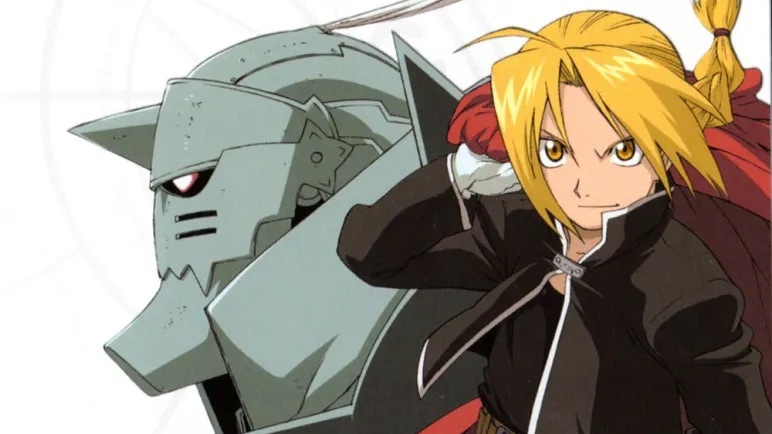
I have a deep appreciation for the 2003 adaptation of Fullmetal Alchemist because it encompasses everything I just described in a beautiful way. While it and its manga-faithful counterpart, Fullmetal Alchemist: Brotherhood both explore this notion, 2003 has far more gravitas when it comes to how it portrays relationships. The main reason this gravitas exists is because 2003 exists entirely on the basis of emotional intelligence and consequence, as we see with the Elric brothers and the existence of the Homunculi.

Edward and Alphonse Elric both adore each other immensely, despite any quarrels the two find themselves in. As the story goes, upon attempting Human Transmutation, a taboo in the alchemic realm, Al loses his body as punishment and Ed loses his leg. Fearing he would lose his brother; he sacrificed his arm to bind Al’s soul to a suit of armor. Rewatching the series for my FMA 2003 video I released last year, I noticed a nuance in the English dub. If Al isn’t around when Ed speaks about their goal, there are several instances where his phrasing goes from “we are going to get our bodies back” to “I’m going to get Al and I’s body back” or just “I’m going to get Al’s body back”. Despite Ed’s immature outlook on several things that 2003 is going to teach him severely, his wording is deliberate. The placing of the “I” pronoun seemed natural to me at first, since English is my first language and placing yourself at the end of a sentence is what we do in speech and writing (grammar is everything, as I am sure Lisa can attest), but upon further reflection, Ed isn’t a formal person. He is hot-headed, jocular, and often uses the term “me”. So why is something small like saying “Al and I” so big? There are two reasons: Ed is the person who wanted to do Human Transmutation to bring their mother back to life. He knows his recklessness caused the boys’ tragedy. Despite Al reaffirming Ed that he was a willing participant, Ed, as the older brother, cannot allow Al to take responsibility even if everyone else will. Ed, at any point in the story, from beginning to end, either ends with “I” or says he will get Al’s body back because to him, Al living a normal life is his brother’s true endgame. Multiple times in the series, we see Ed lay his life on the line, willing to sacrifice everything, just to keep his brother safe. While not always calculated before execution, Ed’s M.O. is to make Al’s life bearable. It may seem like his sense of responsibility and accountability are what drives him, and those are valid factors, but above all else, it is because he loves Alphonse more than anyone, including himself.
As I stated earlier, I find 2003 fascinating because it exists as a series of consequences in a way that Brotherhood does not; that being the conception of the Homunculi. Though not all of them are explored, we see that a mix of love and grief act as the catalyst of a Homunculi being born. Named after the seven deadly sins, which they embody well in Brotherhood, their names are more so byproducts of their creations in 2003, all of which stem from failed Human Transmutations. Ed and Al created Sloth when trying to bring their mother back to life. Hohenheim and Dante tried to bring their dead son back to life, who became Envy, a being that hates both his father for abandoning him and his brothers for existing. Scar’s brother’s failed attempt brought Lust into existence, one that is more pained and well storied than her Brotherhood counterpart. Izumi Curtis, as she did in all iterations of the story, attempted human transmutation to revive her stillborn child, which gave birth to Wrath. All of these came from a sincere sense of love and loss, and the consequences left both the alchemists and the Homunculi damaged. While the alchemists have both physical and emotional scars from their failed attempts, the Homunculi feel human emotions in 2003. Rather than being pawns for a grand scheme like they are in Brotherhood, most of the Homunculi in 2003 are driven by desire that would free them of the existence foisted upon them.

In Fullmetal Alchemist 2003, love, responsibility, and consequence are the most prominent themes. The bond between brothers, the fallout between lovers, the never was, and those who once were, are what makes what many call a “dark” anime a true cautionary tale. The world is not black and white, there is no true equivalent exchange, every action has a reaction, and love is not just a powerful emotion, but as shown in 2003, can also be weaponized. We are always bound to disappoint and be disappointed by those we love, and 2003 put that on full display.
What I love most about the series is that there are resolutions. And not all of them are happy, nor do some make sense without the companion finale film, Conqueror of Shamballa (can we get a Blu-ray release, please?). But that’s real. Love hurts. But no matter what shape it takes form in, it always exists. Oddly enough, Fullmetal Alchemist 2003, though its heart wrenching 51-episode run, makes it comforting and beautiful.

Cameron Allison is a professional film and television critic, content creator, and film curator. Mixing criticism with content creation, he works to validate the merit and value of all things animation and manga, researching themes that are portrayed not only through plot and characters, but also setting, music, and fashion among other things. Outside of content creation, he curates films for his city’s local museum, many of which are animated, and builds community events around his screenings, creating a through line for people who may find museum culture inaccessible and affirming that art exists outside of still images and statues; that animation is art.
In his spare time, Cameron is very much a homebody. He enjoys playing Pokemon, collecting Blu-rays, DVDs, and manga, and singing Sonic the Hedgehog music in the shower, much to his neighbors’ amusement. He is currently doing research for his seventh volume of The Home for Anime podcast and for video essays that involve the Carousel of Progress, Sonic the Hedgehog, and how fashion tells the stories of his favorite characters, starting with Perona from One Piece. He is also planning world domination, but keeps getting distracted by watching cat videos.